Monday, October 24, 2016

Dragon Spotlight 15: Bakunawa

This week we’re departing from India and the Middle East to cover Southeastern Asian dragon myths!  There are some great ones ahead, so give yourself permission to get just a little bit excited.
Our first dragon is the bakunawa, a dragon indigenous to the Philippines who is famous for trying to eat the moon.  In fact, the stories say that there were once seven moons who the moon goddess Bathala created - but this was before the bakunawa ate them.  Bakunawa has two sets of wings, whiskers on his face, a red tongue, and an enormous mouth.  In most stories he is a serpent, but in some he is more like a shark.
There are several stories about Bakunawa, and why he ate most of our moons.  Some say he was irresistably attracted to the moons and their beauty.  Others say he was angry over the death of his sister, a sea turtle who laid her eggs and caused the tides to gradually rise until one night, the humans on the island she visited captured and killed her.  The goddess Bathala sided with Bakunawa, touched by his grief, and refused to punish him for eating six moons.  In another story, Bakunawa fell in love with a human woman, and their happiness was destroyed when the villagers found out and burned her home to the ground.  Bakunawa ate the moons in a fit of rage and vengeance, and Bathala punished him, banishing him to the sea.
But Bakunawa is not content to stay at sea.  Often the waters rise as he tries to come back home, and whenever there is an eclipse of the moon, it is said that he is trying to eat the last one.  In some places, the tradition is for people to bang pots and pans at an eclipse, driving the bakunawa away.


Rachel’s illustration of the bakunawa is based on a basking shark, since some descriptions of bakunawa make him seem shark-like.  The basking shark, as seen below, has a massive mouth (the better to swallow the moon with) and are found in the waters off of the Philippines.  She also gave it bioluminescent patches, like many creatures who live in dark deep-sea waters have, to help it in both its aquatic environment and during its missions to the darkness of outer space.


Monday, October 17, 2016

Dragon Spotlight 14: Vritra

In India, there is a Hindu god named Indra who brings rain and ensures the health of the land.  This mighty warrior god has an archnemesis in the powerful demon Vritra.
A snake so large his head reached into the clouds, Vritra is the demon of drought, a title he gained by stealing all of the world’s water.  He channeled all of the water in the world and kept it contained in a mountain without concern for the people of the world who were dying of starvation and thirst.  Despite how terrible the drought was, no warriors wanted to challenge Vritra - but Indra rose to the challenge.  He armed himself with several lightning bolts and rode an elephant to Vritra’s mountain.  There, the young storm god fought the great snake for many hours.  Vritra clawed at him, and he threw lightning at the dragon.  Finally, Vritra came too close to Indra and Indra struck at his legs, severing them.  As Vritra let out a terrible cry, Indra finished the dragon by cutting him in half.  He then released the water back into the world.


In this sneak peek of our illustration, you can see the water gushing out of Vritra’s mouth.  Rachel’s drawing of Vritra takes inspiration from both Indian statues and the bizarre horned toad species of Southeast Asia, pictured below.  


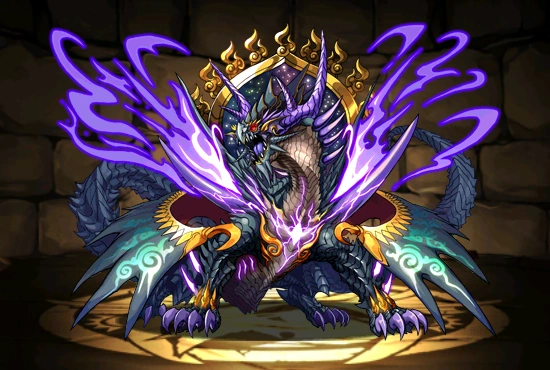
In recent pop culture, Vritra has been featured in the game Puzzle & Dragons as - fittingly - a dark dragon.


Monday, October 10, 2016

Dragon Spotlight 13: Ti'amat

The story of Ti’amat has undergone many changes over time.  In the Babylonian creation story, Ti’amat - like Illuyankas, from last week - is chaos personified in dragon form.  A brave warrior named Marduk eventually defeats her and restores order to the land.  However, in earlier Sumerian versions of the story, Ti’amat is the goddess of salt waters and creates the land along with her partner Apsu, god of the fresh waters.  

In addition to creating the land, Ti’amat and Apsu also have many children who are gods and goddesses themselves.  Because their children constantly kept them up at night, Apsu planned to spread them across the world, but one child - Ea - dissented.  He killed Apsu and tried to kill his mother Ti’amat, but she fought off his attack.  She then organized a war against Ea, with many of her children by her side, including her son Kingu as commander.  Ea chose his son Marduk to lead the rebel forces, and Marduk used not only spears and a club and a bow and arrow, but also his powers of wind and lightning.  Ultimately, Marduk triumphs and the story morphs from one of a rebellious grandson to a marvelous hero defeating the evil dragon.

Ti’amat, after creating the lands, then literally became them - all of the features of the earth are said to rest upon her back.  In Rachel’s illustration of Ti’amat, you can see the mountains along her back.  Her design is based loosely on the sturgeon, as seen in the two rows of bony scutes running down her sides. Rachel chose the sturgeon because they are a primitive group of fishes, much like how Ti’amat is one of the first recorded dragon myths.


In popular culture, Tiamat is a queen, goddess, and mother of evil dragons in the game Dungeons and Dragons.  Tiamat is also the name of a 1980s Swedish metal band.  Rock on, Ti’amat!


Monday, October 3, 2016

Dragon Spotlight 12: Illuyankas

Our story this week revolves around the ongoing fight between Teshub, the storm god, and Illuyankas, the dragon of chaos.
In Hittite mythology, Teshub fought Illuyankas constantly.  In one of their fights, Illuyankas came close to defeating Teshub, and even though the god survived, he called upon his daughter the goddess Inara, to help defeat the dragon and protect mankind.  Inara then called upon a human man named Hupasiya to join on their quest.  Taking advantage of the dragon’s greed, Inara threw a great feast and lay enchantments on the food and wine so that it would never run out.  Illuyankas and all his serpent children ate and drank until they passed out along the tables.  Then Hupasiya, who had been hiding in the dining hall, bound them with ropes and had Teshub scatter them across the land.  But this only kept the dragons’ chaos at bay for another year.
There are many stories of battles between Teshub and Illuyankas, since their fight was to be everlasting.  Each year when the Hittite new year was celebrated, it was said that Teshub clashed with Illuyankas.


Rachel’s drawing shows the dangers of draconic drinking, with Illuyankas having partied just a little too hard at the feast.
Below is a carving depicting Teshub killing Illuyankas from 850-800 BC.  An outlined version of the picture shows the shape of the dragon more clearly.


Come back again next week for more Middle Eastern dragons!  

Tuesday, September 27, 2016

Dragon Spotlight 11: Gandarewa

Our featured dragon this week hails from Iranian mythology.  Gandarewa was so large that, although he lived in the ocean, the water merely pooled around his ankles.  As he grew ever larger, he began eating humans and livestock alike.  He also jealously guarded the haoma plant, keeping its powerful medicine for himself.  One brave man named Keresaspa went into the sea to fight Gandarewa and stop his destruction.


Keresaspa was losing the battle until he grabbed the skin on the sole of Gandarewa’s foot and, with a mighty yank, snatched his skin from his entire body.  He tied up Gandarewa in his very own skin, dragging him ashore.  But despite his immense pain, the sea beast suddenly slashed at Keresaspa’s eyes, blinding him for just a moment.  It was long enough for Gandarewa to escape, and he proceeded to wreak more destruction on humankind than ever before.  His turned his attention to the home of Keresaspa especially, eating all of his horses and stealing his wife and children to bring back to his undersea abode.  Keresaspa’s wrath over this was so great that he marched into the ocean, dragged Gandarewa ashore, and clubbed him to death on the beach.  Afterwards, Keresaspa’s family and all of Iran was safe from the dragon’s wrath.


In Rachel’s drawing of Gandarewa, he is guarding the haoma plant, displaying his greed and jealousy.  This version of Gandarewa draws influence from the Permian era fossil amphibian Diplocaulus. His skin and external gills are like those seen in extant larval salamanders. Of course, real amphibians cannot survive in salt water.  Below is an image of a Diplocaulus fossil, estimated to be at least 251 million years old.


Gandarewa shows up in pop media today, notably in the Final Fantasy series as a holy man who went into the mountains, fed on dragon blood, and was changed forever.

Monday, September 19, 2016

Dragon Spotlight 10: Leviathan

Greetings all!  As the semester continues, so does our weekly dragon spotlight!  As promised last week, we’ll be looking at the great water beast Leviathan, a monster so popular that its name can substitute for any enormous sea monster.

Leviathan is described in Job 41 in the Old Testament with many dragon like features:

14 Who dares open the doors of its mouth,
     ringed about with fearsome teeth?
15 Its back has rows of shields
     tightly sealed together;
…
18 Its snorting throws out flashes of light;
      its eyes are like the rays of dawn.
19 Flames stream from its mouth;
      sparks of fire shoot out.

As time moved on, Leviathan was paired with increasingly fierce descriptions, so that in many Christian texts the Leviathan is given an more evil connotation and has even been said to swallow the souls of the damned on Judgement Day.  


Rachel’s drawing of Leviathan is based on the mosasaur. Mosasaurs (which were recently featured in the film Jurassic World) are an extinct group of marine reptiles, distantly related to modern monitor lizards. These aquatic predators are thought to have swallowed their prey whole like a snake, and so they make for perfect inspiration for Leviathan, who is associated with swallowing souls.

Like our friend Behemoth from last week (and the Leviathan’s possible partner in crime), this fearsome sea dragon has inspired films.  In fact, Leviathan has been the title of two films, one in 1989 and another, from Russia, in 2014.


If you've ever seen either one, or have the time to watch them, let us know what they're all about! Until next week, dragon fans!

Monday, September 12, 2016

Dragon Spotlight 9: Behemoth

     With the start of a new semester, we are back and bringing dragons back with us!  This semester at UMass Amherst our developing text, A Discourse on Dragons, will be used in a 3-credit course on dragon mythology around the world, taught by our own Dr. Jean Foward!

    Picking back up on our weekly dragon spotlight, this week we'll be looking at Behemoth, from the Old Testament. Behemoth is often depicted as either an ox or a hippopotamus, but is usually described alongside Leviathan, who will be our dragon spotlight next week. Some texts describe God creating the male Behemoth as a counterpart to the female Leviathan. Still other iterations speak of God slaying both Behemoth and Leviathan when Israel is delivered from all enemies to be served as food for the righteous.


   In Rachel's drawing of Behemoth, seen above, he towers over the mountains like a gargantuan sauropod dinosaur. He is historically depicted as a bull, so he is drawn here with bull-like horns and ears.

   Many Christian sources draw a link between Behemoth and dinosaurs, especially Brontosaurus.  Often Behemoth is depicted as a Brontosaurus, Brachiosaurus, or a comparable dinosaur.  Additionally, such a Biblically inspired monster was featured in a 1959 sci-fi horror flick, "Behemoth the Sea Monster," in spite of the fact that Behemoth  was more often related to land, while Leviathan was associated with the sea.


Check back in next week, when we’ll be taking a look at Leviathan!